We Are Losing the Ability to Understand the World
My view from the last days of modernity


I feel that our world is coming to an end, and we will be maladapted to what comes next. If you believe the triumphal songs of the bosses and masters, AI will take my job and maybe every job. Then it might kill us. My primary concern is neither economic nor apocalyptic, but the undoing of the foundations of our era’s culture. The project of modernism rests on the belief that human minds can understand the world. In a world of fully self-improving autonomous systems, this seems dubious. Collective hallucinations are common among technology workers, but this future seems so certain it may as well have already happened. Prophetic past tense and all that. I am in mourning, not denial of this future.
How the modern world was invented.
If we stand upon its grave, then let’s look back upon the birth of modernism. Systems of commerce, scientific progress, and state centralization became self-perpetuating, coalescing into the single phenomenon of modernity. Once the logic of modernism took hold, its consequences were so significant that they reshaped the world. In Europe, we saw nationalism, secularism, and the destruction of small languages, cultures, and principalities. It required populations to reject natural rhythms and embrace constructions, regularity, and measurement. Old languages and tribes were subjugated for the sake of global communication, international markets, and better lives. Ancient rights were trod upon, and the commons were stolen. Modernism was violent, and millions were killed in its name. All of this was necessary for penicillin, refrigeration, aviation, and life spans exceeding fifty.
The violence inherent in the transitioning age was not accepted without conflict. More interesting than the machine-smashing Luddites were the transcendentalists. Transcendentalism rejected modernity’s systems, favoring self-reliance over markets and divinity over rationalism to break free from its forces. They correctly saw that modernity was ultimately a conflict of the mind. It required more than economic or political systems; it required rationalism itself, and the rejection of nature’s divinity. Just as modernity created new ideas, it created people. Beliefs in human understanding, rationality, and secularism became core aspects of human identity. Those who gave themselves over to this thinking became the most successful in the new world. However, retreating into nature and self-reliance only provided individual relief from encroachment. Today, you pay tickets to park at Walden Pond.
It could be a world built by people. Modernism promised that we would project platonic models onto the earth. The ancients would measure distance by the pace of a hoplite’s daily march, varying in its objective distance with the terrain. Understanding the world in “miles” allowed us to measure and therefore master it. With land surveyors and engineers, factories and technology, we would then reshape the world. The cowboy who once drove his herds across the shared lands of the open range was stopped by cheap barbed wire. The frontier became a grid of squares, and changed the kind of mind the land required.

The foundational requirement of modernity, along with its economic and political systems, is that the world is comprehensible. After centuries of acceptance, this belief has become naturalized, like the iron within our blood. Yet by enabling mechanized thought, we may necessarily reject human understanding.
The last thing we understand
Systems that are built by unhuman intelligence lie outside our full comprehension. I already see this in the code I write. It once required intense focus on each logical step. That understanding is disappearing in an era of rapid, prompt iteration. As these systems become more complex, expansive, and totalizing, we will lose touch with their underlying logic. Robotic self-optimization erases the frictions and limits that once made systems legible to human thought.
Rationalism is not merely the expression of logic; it is the belief that the world can ultimately be understood. Our systems may technically remain understandable, but the speed and magnitude of their automatic change will erode our confidence. Rationalism will give way to mystery as attempts to internalize our understanding are outpaced by the deployment of newer complexities. Taken to its extreme, we arrive at a world unfamiliar to rationalism itself. We return to an era of unknowing.
My world is already changing. The small secrets of my profession have become worthless. Learning Python decorators feels foolish when Python’s core philosophy now seems to articulate its uselessness. Day by day, the world I was built for passes into memory. The self-reinforcing capabilities of the machine promise that today’s limitations will be surpassed. It is hard to imagine my place in the future. Certainly, it will not be as lucrative—or as interesting—as the one I inhabit now. As a privileged son of America, I never believed I would be trampled by history. An innate sense of peerlessness tricked me into believing I would rise above the eddies of the day. I am now far less certain. I feel like a cowboy of the dying West watching the wires pull around him.
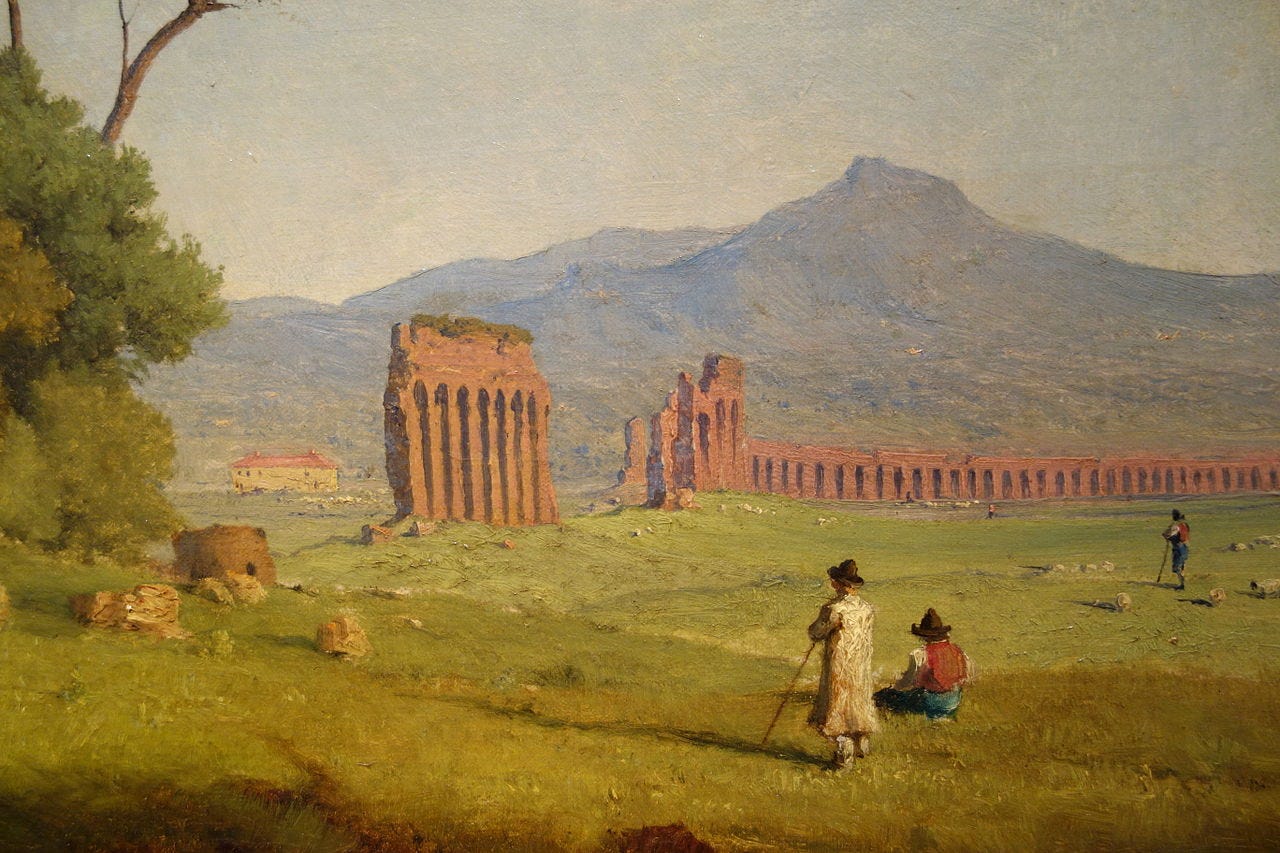
I do not believe in a future of a god in a box, or a nation of geniuses living in a computer. But I feel that our world will change. If AI changes the world around me, I will return to older ways of living and thinking. Tradition, spirituality, craft, and the liberal arts will provide what the machine cannot, a life outside its recursive self-improvement. When Rome collapsed, some men left the cities and built monasteries. They could not stop the world’s transformation, so they preserved what was worth saving.
In all the superficial discourse about AI, this gets at something deep about our culture that I haven’t quite seen articulated before